This text has the objective to highlight the meme genre in the context of the Creative Writing Theory (MALEY, 2012) as an effective proposal to develop reading and writing skills in English.
According to the site Dictionary.com
The word meme, coined in 1976 by the evolutionary biologist Richard Dawkins, goes way beyond social-media pixels. Meme captures the concept of “cultural transmission” of ideas in general, where customs and ideas spread from brain to brain.
This information reinforces the premise that meme is not a new genre, but it has changed a lot throughout the times in terms of format, function, purpose and audience.
Lara and Mendonça (2020) discuss the dissemination of memes on the internet nowadays, pointing out that:
[…] currently in Brazil there is intense production and diffusion of this genre for diverse purposes. It circulates in virtual environments (social networks, blogs, Whatsapp and similars) and in different fields of human activity, even in those whose perception is of absolute formality. They are also utterances that can be composed of verbal, visual or verbal-visual materialities, which convey humour and re-signify images, events, stereotypes and phrases so that this purpose can be achieved. (p. 199)
As a genre that has been circulating diversely in our daily life, we can affirm a meme is originated from a creative moment of that one who produced it, intentionally provoking humour. However, it is relevant to consider that to produce meaning and humour, its reader needs to share the same social context and level of knowledge of that meme producer. That is, it is not easy to understand a meme related to another culture, which focus on a politician or a celebrity who is not well known in Brazil, for example.
Lara and Mendonça (2020, p. 199) also call attention to the fact that a meme has some specific characteristics, it is punctual ephemeral and not everlasting, that is, it is very related to a fact or a person in a right moment of history.
At Letras, in the course Reading and Writing Practices, the students have been challenged to language practices which possibly contribute to the mastering of their English skills and brush up on their communicative competence. To reach this objective, the course was planned considering the parameters of the Creative Writing Theory (CW).
In this context, CW (MALEY, 2012; BABAEE, 2015) is a relative new perspective that can help to motivate students’ practices at the university at the same time it will contribute for their development as language teachers. Maley (BABAEE, 2015, p. 77) in an enlightening interview defines CW as “any kind of writing which has an aesthetic or affective rather than a purely pragmatic intention or purpose.
The author defends of his purpose arguing that CW gives a real boost to the learners’ self-esteem, that is they realize they are able to produce texts in the target language. They also can ‘play’ with the language while they are learning and developing their skills, without the fear of reproof (BABAEE, 2015, p. 77 -78). Among other arguments, it is important to highlight that CW is motivating, challenging and helps a lot the creativity development of those who practice it.
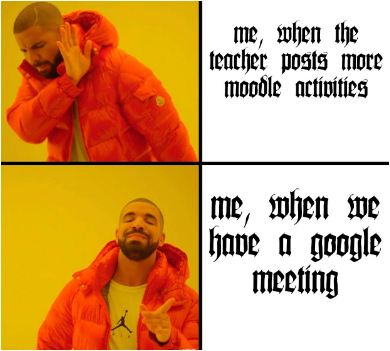
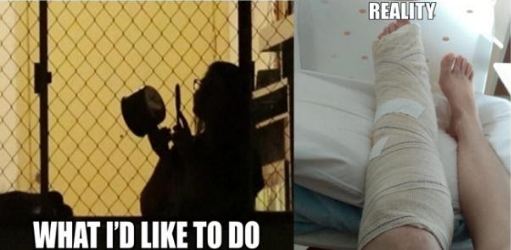
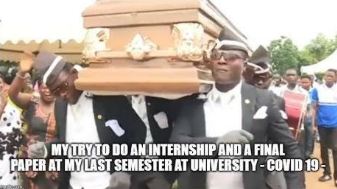
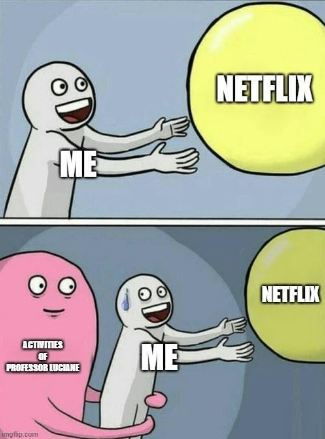
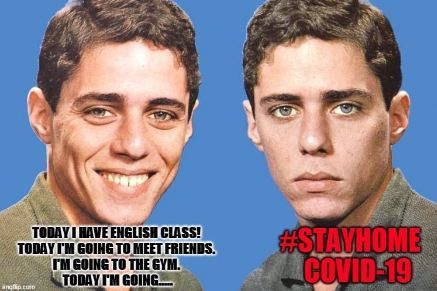
During this period of isolation, our course did not stop, and the students have been working a lot in their language practices. Their productions have been posted on Moodle and moreover on the public Facebook Group ‘Internationalization at Home’ which belongs to the Extension Project with the same name, where other people can appreciate them. For the ‘meme task’ they had to read about this genre and create theirs, choosing among these themes:
- Learning/studying English in times of isolation.
- Using social media to learn/study.
- Loneliness in times of isolation.
- Friendship in times of isolation.
To sum up, this proposal is a way to join English language practice and teacher competencies, because all the tasks which have proposed can be (re)dimensioned for all levels of the school environment.
Here you have some of these memes produced this semester.

References
BABAEE, R. Interview with Alan Maley on teaching and learning creative writing interviewed by Ruzbeh Babaee. International Journal of Comparative Literature & Translation Studies. ISSN 2202-9451 Vol. 3 No. 3, 2015.
LARA, M. T. de A.; MENDONCA, M. C.. O meme em material didático: considerações sobre ensino/aprendizagem de gêneros do discurso. Bakhtiniana, Rev. Estud. Discurso, São Paulo , v. 15, n. 2, p. 185-209, June 2020 . Available from <http://www.scielo.br/scielo.php?script=sci_arttext&pid=S2176-45732020000200185&lng=en&nrm=iso>. access on 26 Apr. 2020. Epub Apr 17, 2020. https://doi.org/10.1590/2176-457342169.
MALEY, A. (2012) Creative Writing for Students and Teachers – Humanising Language Teaching. Available at https://old.hltmag.co.uk/jun12/mart01.htm
MEME. In: Dictionary.com. Random House Unabridged Dictionary. Disponível em: https://www.dictionary.com/e/the-original-memes-before-memes-listicle/ . Acesso em: 20/03/2020.
INTERNATIONALIZATION AT HOME. Curso de Letras UPF. Facebook Group. Disponível em https://www.facebook.com/groups/internationalizationathome/. 2019. Acesso em 24 de abril, 2020.
Texto escrito pela Prof. Dra. Luciane Sturm, da graduação e pós graduação da UPF
 Revista Letrilhando